
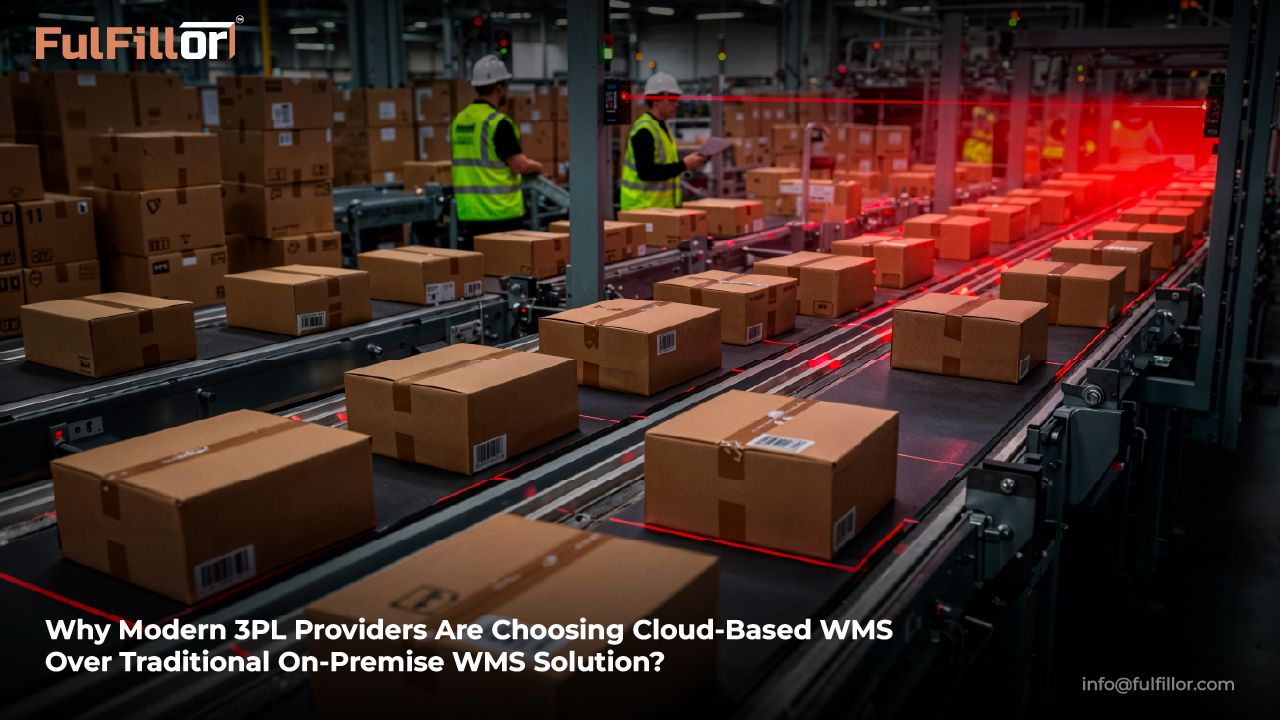
Third-party logistics providers are under growing pressure to manage faster order cycles, more sales channels, higher client expectations, and increasingly complex fulfillment workflows. Traditional warehouse systems often struggle to keep up with this level of operational demand.
Cloud-based warehouse management systems help logistics service providers manage inventory, orders, picking, packing, shipping, billing, and reporting from one connected platform. Instead of relying on heavy on-premise infrastructure, a cloud WMS gives warehouse teams real-time visibility, faster user onboarding, easier integrations, and better support for both B2B and direct-to-consumer fulfillment.
For 3PL companies, the right WMS can improve speed, accuracy, labor efficiency, client visibility, and profitability. In this article, we’ll look at how warehouse management technology has evolved, why more warehouse operators are adopting cloud-based systems, and which emerging trends are shaping the future of logistics and outsourced fulfillment operations.
How Warehouse Management Systems Have Evolved
Warehouse management systems were traditionally deployed on company-owned servers and managed by internal IT teams. While this model gives businesses greater control over infrastructure and system configuration, it also places responsibility for maintenance, updates, security, backups, and hardware on the warehouse operator.
Cloud-based WMS platforms changed this model by allowing warehouse teams to access inventory, orders, fulfillment workflows, and operational data through provider-hosted software. This has made it easier for growing 3PLs to add users, clients, integrations, and warehouse locations without expanding local server infrastructure.
For a detailed comparison of both deployment models, see our guide to cloud-based vs on-premise WMS.
Why Warehouse Operations Are Moving Toward Cloud WMS
Early warehouse management systems were usually built as on-premise platforms. They required local servers, internal IT support, manual upgrades, and ongoing infrastructure maintenance. That model worked for many traditional warehouses, but it can become difficult to scale when fulfillment providers need faster onboarding, multi-client workflows, real-time reporting, and easier ecommerce and carrier integrations.
Modern warehouse operations are moving toward cloud-based WMS platforms because they are easier to deploy, update, access, and scale. Instead of managing software on local infrastructure, warehouse teams can use a cloud system to manage inventory, orders, picking, packing, shipping, billing, and reporting through a connected online platform.
Market demand also reflects this shift. Market demand also reflects this shift. According to MarketsandMarkets, the global warehouse management system market was valued at USD 4.57 billion in 2025 and is projected to reach USD 10.04 billion by 2030, growing at a CAGR of 17.1% during the forecast period.
Why 3PL Providers Are Adopting Cloud WMS
The shift toward cloud WMS is being driven by operational needs rather than technology alone. Growing 3PLs increasingly need systems that can support more clients, warehouse locations, integrations, and order volume without creating the same level of infrastructure overhead.
Key adoption drivers include:
- Faster access to warehouse data: Teams can view inventory, orders, shipments, and operational activity from authorized internet-connected devices.
- Lower infrastructure dependency: Provider-hosted software reduces the need to maintain dedicated WMS servers and manage every software upgrade internally.
- Easier operational scaling: Warehouses can add clients, users, locations, channels, and integrations as operations grow.
- Faster connectivity: Modern cloud platforms can make it easier to connect ecommerce platforms, marketplaces, carriers, ERP systems, and other fulfillment tools.
For a deeper look at the operational advantages, see our guide to the benefits of cloud-based 3PL WMS.
Emerging Trends in Cloud-Based 3PL WMS
Cloud-based WMS is no longer only about remote access and lower IT dependency. Modern fulfillment providers are also using cloud warehouse systems to improve automation, reporting, client visibility, and operational control.
Key trends include mobile barcode workflows, AI-assisted warehouse insights, real-time client portals, automated 3PL billing, API-based ecommerce and carrier integrations, stronger user access controls, and multi-warehouse visibility.
These trends matter because growth usually brings more SKUs, more sales channels, more client rules, more shipping requirements, and more pressure on warehouse teams. A cloud WMS gives logistics teams a practical way to manage that complexity while keeping operations easier to access, update, and scale.
How Fulfillor Supports Modern Fulfillment Operations
Fulfillor is built to support modern fulfillment operations with inventory management, order processing, picking and packing, shipping workflows, client visibility, 3PL billing, and warehouse reporting in one cloud-based system.
See how Fulfillor helps fulfillment providers manage inventory, orders, shipping, billing, and client visibility from one connected cloud WMS.
FAQs About Cloud-Based 3PL WMS
1. What is a cloud-based 3PL WMS?
A cloud-based 3PL WMS is warehouse software hosted online. It helps logistics providers manage inventory, orders, picking, packing, shipping, billing, and client visibility without maintaining local servers.
2. Why are 3PL companies moving to cloud WMS?
3PL companies are moving to cloud WMS because it is easier to deploy, update, access, and scale than traditional on-premise systems. It also supports real-time warehouse visibility and faster integrations.
3. How does cloud WMS help fulfillment providers scale?
Cloud WMS helps fulfillment providers scale by supporting more users, clients, SKUs, order volume, warehouse locations, and sales channels without large infrastructure upgrades.
4. Can cloud WMS support both B2B and D2C fulfillment?
Yes. A cloud WMS can support B2B and D2C fulfillment through flexible order workflows, inventory rules, shipping logic, client reporting, and ecommerce or ERP integrations.
5. What are the biggest cloud WMS trends for 3PL providers in 2026?
Cloud WMS trends for 3PL providers include mobile barcode execution, API-first integrations, AI-assisted operational analytics, automated 3PL billing, real-time client portals, stronger role-based access controls, and centralized visibility across multiple warehouse locations. These capabilities help fulfillment providers manage increasing client, inventory, channel, and order complexity from connected systems.