

Why Inventory Write-Offs Matter in 3PL Warehouses
In 3PL warehouses, inventory write-offs often happen when client-owned stock becomes damaged, expired, misplaced, over-aged, or incorrectly adjusted. The problem is rarely one major failure. It usually starts with small gaps in receiving, lot tracking, returns handling, cycle counts, and inventory visibility.
In most 3PL relationships, the client owns the inventory and makes the final accounting decision. The warehouse records the stock’s quantity, condition, status, location, and disposition. These operational records support the client’s decision to retain, write down, or write off the inventory.
Without real-time inventory visibility and clear warehouse controls, 3PLs struggle to track client-owned stock accurately and prevent avoidable losses.
Inventory Write-Offs vs Write-Downs
Inventory write-offs and write-downs are often used interchangeably, but they represent different levels of inventory loss. A write-off occurs when inventory loses all its value and can no longer be sold, usually due to damage, expiration, or obsolescence. A write-down happens when inventory still has some value but must be reduced because of lower demand, pricing changes, or reduced market value.
Inventory shrinkage describes a difference between recorded inventory and the stock actually available. A write-off is the financial treatment applied when the inventory owner determines that the affected stock has no recoverable value. Shrinkage may lead to a write-off, but the terms do not describe the same event.
In 3PL operations, inventory losses may result from inaccurate inventory tracking, poor storage conditions, delayed stock movement, or unclear client-specific rules. They reduce the inventory owner’s asset value and may also create claims, service credits, or client disputes when warehouse operations contributed to the loss.
When Should Inventory Be Written Off in a 3PL Warehouse?
Inventory should usually be written off when it has no recoverable value and can no longer be sold, returned, repaired, transferred, or liquidated. In 3PL warehouses, this often applies to expired products, severely damaged goods, obsolete stock, lost inventory, or returned items that fail inspection.
Before inventory is written off, 3PL teams should confirm the issue with clear reason codes, client approval rules, damage records, expiry data, and inventory reconciliation. This helps avoid unnecessary write-offs and gives clients a clearer record of why inventory value was lost.
Common Causes of Inventory Write-Offs in 3PL Warehouses
Inventory write-offs in 3PL warehouses usually come from repeated operational gaps rather than one major failure. Because 3PLs manage inventory for multiple clients, small mistakes in receiving, storage, picking, returns, or reporting can create losses across different accounts.
-
Obsolescence
Products lose value when newer versions replace them, demand changes, or clients hold more inventory than current demand can support. Slow-moving SKUs can sit in storage too long and eventually become unsellable. -
Expiration
Perishable or shelf-life-sensitive products such as food, pharmaceuticals, cosmetics, and supplements can expire if inventory is not rotated correctly. Poor FIFO or FEFO control increases the risk of expiry-related write-offs. -
Damage during storage, handling, or transit
Products may become unsellable because of poor handling, improper storage conditions, weak packaging, warehouse accidents, or transit damage. Without a clear damage inspection process, sellable and unsellable stock can also get mixed. -
Overstocking due to inaccurate demand forecasting
Ordering or receiving more inventory than needed can result in excess stock that becomes obsolete, expired, or difficult to sell. In 3PL operations, this often happens when clients do not have clear visibility into aging inventory. -
Inventory shrinkage, loss, or misplacement
Stock discrepancies caused by theft, misplacement, scanning errors, or poor bin-level tracking can lead to inventory being written off when it cannot be found or reconciled. -
Administrative and data errors
Mistakes in data entry, receiving records, inventory adjustments, cost allocation, or client reporting can create discrepancies that lead to incorrect stock adjustments. -
Delayed returns processing
Returned items can lose resale value when they are not inspected, graded, restocked, repaired, or disposed of quickly. For 3PLs, slow returns handling can turn recoverable inventory into write-offs.
In high-volume 3PL operations, these issues rarely occur in isolation. Small inaccuracies in inventory tracking, handling, returns, or client reporting can compound over time, leading to avoidable write-offs if they are not addressed early.
Inventory Write-Off Risks and Prevention Methods
| Write-Off Risk | How It Happens in 3PL Warehouses | Prevention Method |
|---|---|---|
| Expired stock | Products sit too long without FIFO or FEFO rotation | Expiry tracking, lot control, and automated alerts |
| Damaged goods | Items are damaged during storage, picking, packing, or transit | Damage inspection workflows and quarantine zones |
| Misplaced inventory | Similar SKUs or client-owned stock are stored across shared zones | Barcode scanning and bin-level inventory tracking |
| Slow-moving SKUs | Clients do not act on aging stock early enough | Inventory aging reports and client dashboards |
| Return delays | Returned products are not inspected or restocked quickly | Returns grading and faster disposition workflows |
| Unapproved adjustments | Inventory is changed without sufficient investigation or authorization | Reason codes, approval controls, and a complete audit trail |
Proven Strategies to Reduce Inventory Write-Offs and Write-Downs
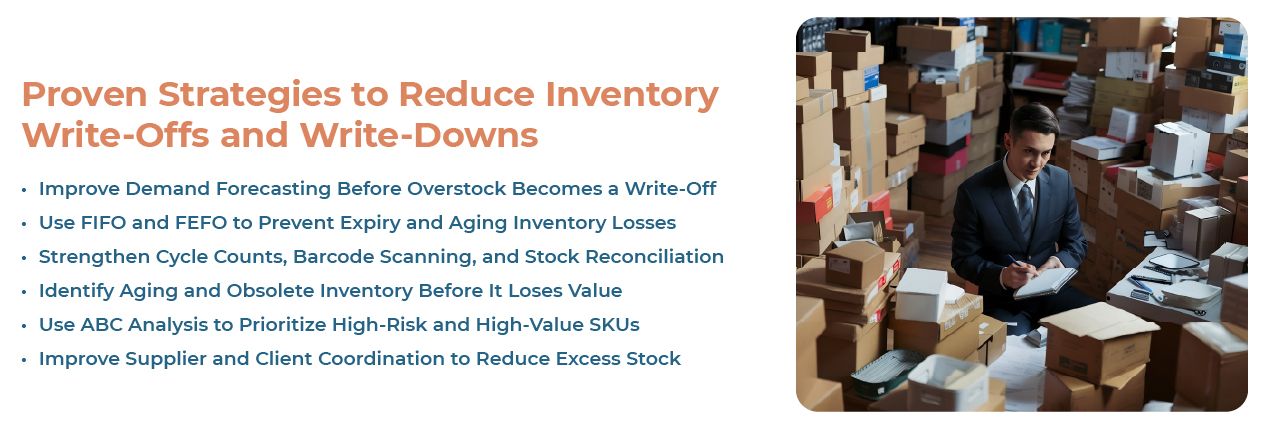
1. Share Inventory Aging Data Before Overstock Becomes a Write-Off
A 3PL usually does not control the client’s purchasing or demand forecasting, but it can show how long each SKU has remained in storage and when its movement begins to slow. Aging reports should separate inventory by client, SKU, lot, expiration date, warehouse, and last movement date.
The warehouse and client can agree on alert thresholds, such as 60, 90, or 120 days without movement. The client can then decide whether to discount, bundle, transfer, return, or liquidate the stock before it loses more value.
2. Use FIFO and FEFO to Prevent Expiry and Aging Inventory Losses
Inventory handling methods directly affect product quality, shelf life, and inventory value. Without structured FIFO or FEFO workflows, older stock may stay in storage while newer inventory is picked first, leading to spoilage, expiry, and avoidable write-offs.
For 3PLs handling food, cosmetics, supplements, pharmaceuticals, or other shelf-life-sensitive products, FEFO workflows and automated expiry alerts are especially important. These controls help ensure older or near-expiry inventory is used before it loses value.
3. Strengthen Cycle Counts, Barcode Scanning, and Stock Reconciliation
Inventory discrepancies are a major contributor to write-offs. When physical stock does not match recorded inventory, 3PL warehouses may need to correct inventory records, investigate missing items, or handle client-facing inventory disputes.
Regular cycle counts, barcode scanning, bin-level tracking, and real-time inventory updates help maintain accurate stock records. Monitoring KPIs such as inventory turnover, shrinkage, adjustment frequency, and write-off rates also helps teams identify problem areas before losses grow.
4. Define Approval and Disposition Rules
Damaged, expired, returned, or questionable inventory should not be adjusted or disposed of without a documented decision. Each client may have different requirements for inspection, photography, quarantine, repair, return, donation, destruction, or liquidation.
Recording these rules in the warehouse workflow helps teams route affected stock correctly, collect the required evidence, and obtain approval before changing its status or quantity.
5. Combine ABC Analysis With Risk-Based Controls
ABC analysis helps warehouse teams apply tighter controls to inventory with greater financial or operational importance. High-value A items may require more frequent cycle counts, restricted access, or additional scan verification.
Value should not be the only factor. Expiration dates, fragility, theft risk, storage conditions, and replacement difficulty can identify lower-value items that also need stronger controls.
6. Review Aging and At-Risk Stock With Each Client
Regular inventory reviews give clients time to act before slow-moving, expiring, damaged, or returned stock loses its remaining value. Reports should identify aging thresholds, upcoming expiration dates, unresolved returns, quarantined units, and inventory awaiting disposition.
The client can then decide whether to transfer, promote, return, repair, liquidate, or dispose of the affected stock. The warehouse remains responsible for providing accurate records and carrying out the approved action.
How Inventory Write-Offs Impact Profitability
Inventory write-offs reduce the inventory owner’s asset value and profitability. For the 3PL, repeated losses may lead to claims, service credits, insurance costs, client disputes, and reputational damage, depending on the cause and contractual responsibility.
Warehouse teams can monitor affected units, damage frequency, expiry risk, inventory-adjustment frequency, aging stock, and time to disposition. When clients provide inventory values, financial exposure can also be included in client-level reports.
Inventory Write-Off Process for 3PL Warehouses
Financial treatment should follow the inventory owner’s accounting policy and applicable reporting standards. The 3PL should maintain accurate operational records before any authorized adjustment is sent to an ERP or accounting system.
A clear write-off process helps 3PL warehouses reduce disputes, improve reporting, and prevent unnecessary inventory losses.
A simple process includes:
- Identify damaged, expired, missing, obsolete, or potentially unsellable stock.
- Place the affected inventory on hold when further movement could interfere with the investigation.
- Separate sellable, damaged, returned, quarantined, and disposable inventory.
- Record the client, SKU, quantity, status, location, reason code, and supporting evidence.
- Confirm whether the inventory has recoverable value and follow the client’s approval rules.
- After approval, update the inventory status or quantity in the WMS.
- Send the authorized adjustment to the client’s ERP or accounting system when required.
- Record the cause and corrective action to prevent the issue from recurring.
This process helps warehouse teams connect operational issues with financial reporting while keeping client-owned inventory records accurate.
How a 3PL WMS Helps Reduce Inventory Write-Offs
Preventing inventory write-offs at scale requires more than manual tracking. A 3PL warehouse management system gives warehouse teams real-time visibility into inventory movement, aging stock, damaged goods, returned items, and client-owned inventory.
A WMS helps reduce write-offs by supporting:
- Inventory aging reports to identify slow-moving SKUs early
- Lot, batch, and expiry tracking for FIFO and FEFO workflows
- Barcode scanning to reduce misplaced stock and inventory adjustment errors
- Damage and exception workflows to separate unsellable inventory from sellable stock
- Client-level inventory visibility for better stock decisions
- Cycle count workflows to improve inventory accuracy
- ERP and accounting integrations to synchronize authorized inventory adjustments
For 3PLs, the biggest advantage is early visibility. Instead of finding out after stock has expired, disappeared, or lost value, warehouse teams can flag risks while there is still time to act.
Reduce Inventory Losses Before They Become Final
Inventory losses are easier to control when warehouse teams identify them early. Accurate receiving, barcode scans, FIFO or FEFO rotation, cycle counts, quarantine controls, aging reports, and documented approvals give clients time to act before inventory loses its remaining value.
A 3PL WMS supports this process by preserving inventory status, location, condition, transaction history, and client-level reporting across the warehouse.
FAQs About Inventory Write-Offs
What is the difference between an inventory write-off and a write-down?
A write-off removes inventory from the financial records when it has no recoverable value. A write-down reduces its recorded value when the amount expected to be recovered from the inventory falls below its current carrying value but remains above zero.
Who approves an inventory write-off in a 3PL warehouse?
The inventory owner normally makes the final financial decision. The 3PL documents the inventory’s condition, quantity, location, reason code, and proposed disposition before following the client’s approval process. Responsibility may vary based on the warehouse agreement and the cause of the loss.
Is a warehouse inventory adjustment the same as a financial write-off?
No. A warehouse adjustment corrects the quantity, status, condition, or location recorded in the WMS. A financial write-off removes the inventory’s remaining value from the owner’s accounting records. The two actions may be connected, but they require different records and approvals.
How can a 3PL warehouse reduce preventable inventory write-offs?
A 3PL can reduce preventable write-offs through accurate receiving, barcode scanning, lot and expiration tracking, FIFO or FEFO rotation, cycle counts, controlled returns, damage quarantine, aging reports, and documented client approval workflows.
What information should an inventory write-off record include?
The record should include the client, SKU, quantity, inventory status, warehouse location, reason code, date, supporting evidence, approval, and final disposition. It should also preserve the related warehouse transactions and the users involved.