
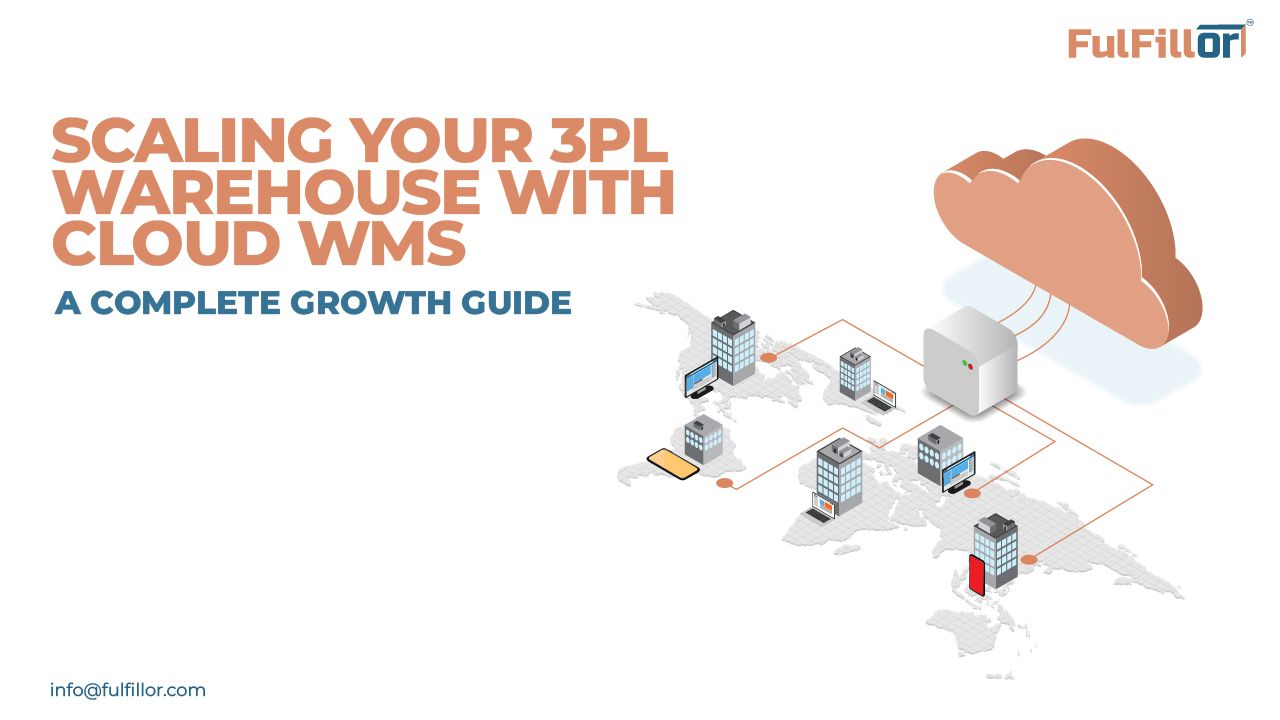
Growth creates a different set of challenges for third-party logistics providers. More clients mean more SKUs, order rules, sales channels, billing requirements, integrations, warehouse users, and service-level expectations to manage at the same time.
Processes that work for a smaller fulfillment operation can become bottlenecks as order volume increases. Inventory updates become harder to control, manual tasks consume more labor, client onboarding takes longer, and disconnected systems make it difficult to maintain visibility across operations.
A cloud-based warehouse management system can help 3PL providers scale these workflows without adding the same level of infrastructure and administrative complexity. This guide explains how cloud WMS supports growing 3PL operations across inventory, fulfillment, client management, integrations, billing, reporting, and multi-warehouse expansion.
What Is a Cloud WMS for 3PL Operations?
A cloud WMS is warehouse management software hosted online rather than on a company's local warehouse servers. For growing 3PLs, the model can simplify access, software updates, integrations, and expansion across users, clients, and warehouse locations.
How Cloud WMS Helps 3PL Warehouses Scale
Scaling a 3PL warehouse means handling more clients, inventory, orders, integrations, users, and warehouse locations without allowing operational complexity to grow at the same rate.
A cloud WMS can support that growth by standardizing warehouse workflows, improving inventory visibility, connecting systems, and providing centralized control across multi-client and multi-location operations. Important features include selecting a system with powerful reporting features, solid inventory management tools, and the ability to handle when business has multiple warehouse locations or client orders at once.
Here are some of the key aspects that you should consider while choosing a cloud based warehouse management system for you 3PL Warehouse:
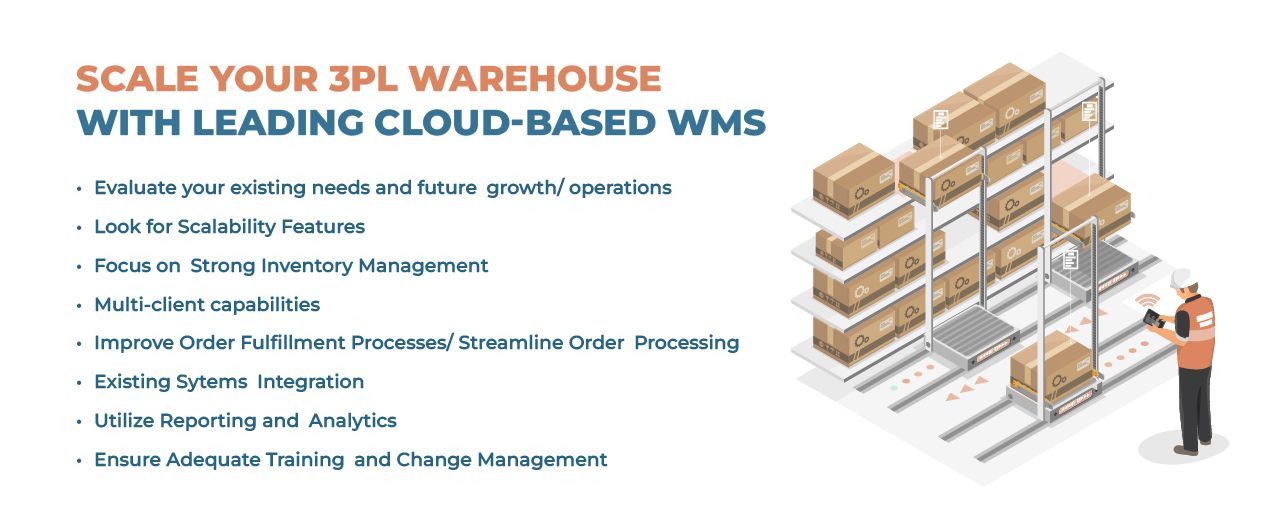
Know When Your 3PL Has Outgrown Current Processes
Before making a move, it’s important to pause and assess the current status of your 3PL warehouse. Understand your current warehouse constraints and expected growth to select a Cloud WMS capable of coping with more order volume, more product types, and potentially different customers. Ask yourself:
- How many orders do you process per day?
- What are the fulfilment challenges we have?
- Are we having difficulty with inventory accuracy?
- Are we ready for surges during peak season?
Identify bottlenecks by talking to your warehouse staff and clients. The proper WMS should resolve your issues now and set you up for future expansion/growth.
Scale Users, Clients, and Warehouse Locations
As a 3PL grows, it may need to add warehouse users, onboard new clients, expand into additional facilities, and connect new fulfillment channels. A cloud WMS can provide a centralized platform for managing this growth without requiring the same level of local infrastructure expansion.
Maintain Inventory Accuracy as SKUs and Clients Increase
As inventory volume and SKU counts increase, maintaining accurate client-level inventory becomes more difficult. A strong warehouse management system supports advanced inventory tracking developed in its application such as real-time visibility of stock levels, lot and serial number tracking, and automated inventory adjustments to ensure multi-client accuracy and to avoid mix-ups.
Onboard More 3PL Clients Without Mixing Inventory and Workflows
Serving multiple clients? Thus, your warehouse management system should be capable of managing orders and dedicated inventory management for multiple clients at a time, and automated stock tracking to avoid mix-ups between clients. Make sure the WMS has separate/custom reporting and billing features to prevent collisions and keep everything clear.
Scale Picking, Packing, and Shipping Without Creating Bottlenecks
Features such as wave picking, pick-and-pack optimization, and automated shipping label generation will help to streamline order fulfillment and minimize processing time.
Add New Sales Channels and Integrations as Clients Grow
Your WMS should integrate with your existing tools — not tear them down. Select a solution that offers seamless integration with your current ERP software (SAP, NetSuite, Microsoft Dynamics), accounting systems (QuickBooks, Xero), e-commerce platforms (Shopify, Amazon, WooCommerce), and shipping carriers (FedEx, UPS, DHL, USPS)
Monitor Warehouse KPIs as Operations Scale
Trying to scale without data-driven insights is like trying to drive blindfolded. Look for a warehouse management system with extensive reporting capabilities that allow you to track Key Performance Indicators (KPIs) and make data-driven decisions. Find a WMS that offers real-time dashboards, and warehouse performance reports that can be customized to your specs. You can then use these data-driven insights to streamline operations, decrease waste, and enhance efficiency.
8. Ensure Adequate Training and Change Management
Standardized training is also important as warehouse teams grow. New users should understand barcode workflows, client-specific processes, exception handling, and reporting requirements. For a detailed rollout process, see our Cloud WMS implementation guide for 3PL warehouses.
Closing Thoughts: Should You Upgrade Your 3PL Warehouse?
Scaling a 3PL warehouse requires more than adding space or labor. Growth introduces more clients, inventory, order volume, integrations, billing rules, users, and warehouse locations that need to remain coordinated.
A cloud WMS can help manage that complexity through centralized inventory control, standardized fulfillment workflows, multi-client management, integrations, reporting, and warehouse billing.
Fulfillor supports growing 3PL operations with connected tools for inventory, orders, fulfillment, shipping, billing, reporting, and multi-warehouse visibility.
Schedule a call to see how Fulfillor can support your growing 3PL operation.