

Third-party logistics providers are managing increasingly complex fulfillment operations as ecommerce growth, multi-channel selling, faster delivery expectations, and expanding client requirements reshape the logistics industry.
A cloud-based 3PL warehouse management system helps logistics providers connect inventory, orders, fulfillment workflows, shipping, client operations, and warehouse data through one accessible platform. Rather than relying on disconnected systems or locally maintained infrastructure, 3PLs can use cloud WMS technology to support more connected and responsive logistics operations.
As ecommerce and outsourced fulfillment continue to grow, cloud warehouse technology is changing how logistics providers manage day-to-day operations. In this guide, we explore how cloud-based 3PL WMS is transforming modern logistics through connected workflows, real-time visibility, multi-client management, integrations, and more efficient fulfillment execution.
What Is a Cloud-Based 3PL Warehouse Management System?
A cloud-based 3PL warehouse management system (WMS) is warehouse software hosted in a cloud environment rather than entirely on company-managed servers. It enables third-party logistics providers to manage inventory, orders, fulfillment workflows, shipping, client operations, and warehouse data through a centralized system.
For multi-client 3PL operations, cloud WMS software can provide real-time visibility across inventory, orders, clients, users, and warehouse locations while reducing the need to maintain the WMS application infrastructure internally.
How Cloud-Based 3PL WMS Is Transforming Modern Logistics
Instead of managing warehouse activity through disconnected software, spreadsheets, and manual updates, 3PL providers can use connected workflows to improve operational visibility and coordinate fulfillment activity across multiple clients and locations.
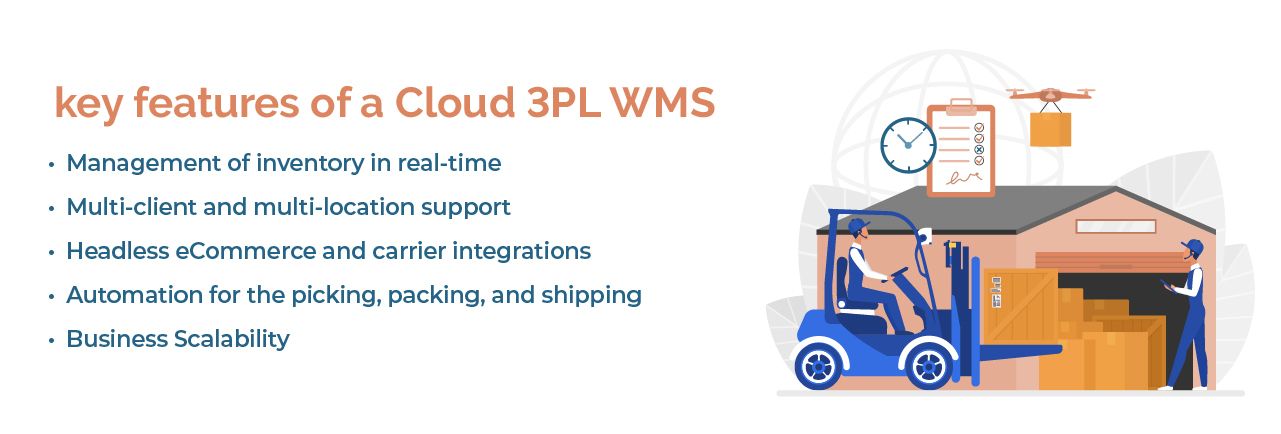
Real-Time Inventory Visibility Across Clients and Warehouses
Modern 3PL operations need accurate inventory visibility across clients, SKUs, warehouse locations, and fulfillment workflows.
A cloud-based WMS can centralize inventory activity so warehouse teams can view stock availability, locations, allocations, receipts, and order movements as operations take place.
For multi-client 3PLs, this is particularly important because inventory must remain clearly separated by client while still being manageable through one warehouse system.
Learn more about inventory management.
Connected Ecommerce, Marketplace, and Carrier Workflows
3PL providers increasingly manage orders from multiple ecommerce platforms, marketplaces, ERP systems, and client systems.
A cloud WMS can connect these order sources with warehouse operations and shipping workflows, reducing the need to manually move information between separate platforms.
Connections with ecommerce platforms, shipping carriers, and accounting systems can help create a more connected fulfillment process from order import through shipment confirmation.
For operations managing a growing number of connected systems, see how an API-driven WMS supports multi-channel fulfillment.
More Standardized Picking, Packing, and Shipping
As order volume and client requirements increase, warehouse teams need repeatable workflows rather than relying on manual instructions or individual knowledge.
Cloud WMS technology can help standardize receiving, picking, packing, shipping, and returns workflows across warehouse teams.
This makes it easier for 3PL providers to maintain consistent operating processes as they add clients, users, order sources, and fulfillment requirements.
Better Multi-Client Operational Control
Managing multiple clients is one of the main differences between 3PL fulfillment and traditional single-owner warehousing.
Each client may have different inventory, order rules, reporting requirements, shipping preferences, billing structures, and user-access requirements.
A 3PL warehouse management system can help separate these workflows while allowing warehouse teams to manage operations through one connected platform.
Greater Client Visibility
As 3PL operations grow, manually answering client questions about inventory, order status, shipments, and warehouse activity can create unnecessary administrative work.
Cloud-based warehouse systems can support more direct access to operational information through reporting tools and client-facing portals.
A 3PL client portal can help clients access relevant inventory, order, shipment, and reporting information without depending on repeated manual status updates from warehouse teams.
More Connected 3PL Billing Workflows
Cloud WMS is also changing how 3PL providers manage billable warehouse activity.
Receiving, storage, fulfillment, handling, returns, and other warehouse services may all create client-specific charges. As the number of clients and services grows, manually tracking these activities becomes increasingly difficult.
Connecting warehouse activity with 3PL billing automation can help providers capture billable events more consistently and reduce administrative work around client invoicing.
Centralized Visibility Across Multiple Warehouses
For 3PL providers operating more than one facility, warehouse growth creates another layer of operational complexity.
A cloud-based WMS can provide centralized visibility across locations while still allowing inventory, users, workflows, and reporting to be managed at the facility level.
This helps logistics providers coordinate operations across a growing warehouse network without relying on completely disconnected systems at each location.
For a deeper look at growth requirements, see our guide to scaling a 3PL warehouse with cloud WMS.
What Cloud-Driven Logistics Means for 3PL Providers
Cloud WMS is shifting 3PL operations away from disconnected warehouse processes toward more connected inventory, fulfillment, shipping, client, billing, and reporting workflows. As warehouse technology continues to evolve, automation, APIs, mobile workflows, and data-driven operations will play a larger role in how fulfillment providers manage logistics.
For a deeper look at what is changing next, read our guide to cloud-based 3PL WMS trends.
How Fulfillor Supports Connected 3PL Logistics
Fulfillor helps 3PL providers manage inventory, orders, picking and packing, shipping, returns, multi-client workflows, warehouse billing, client visibility, integrations, and reporting through one cloud-based warehouse management system.
By connecting these operational workflows, Fulfillor helps fulfillment providers manage increasing logistics complexity while maintaining visibility across clients and warehouse operations.
Schedule a call to explore how Fulfillor can support your 3PL fulfillment operations.